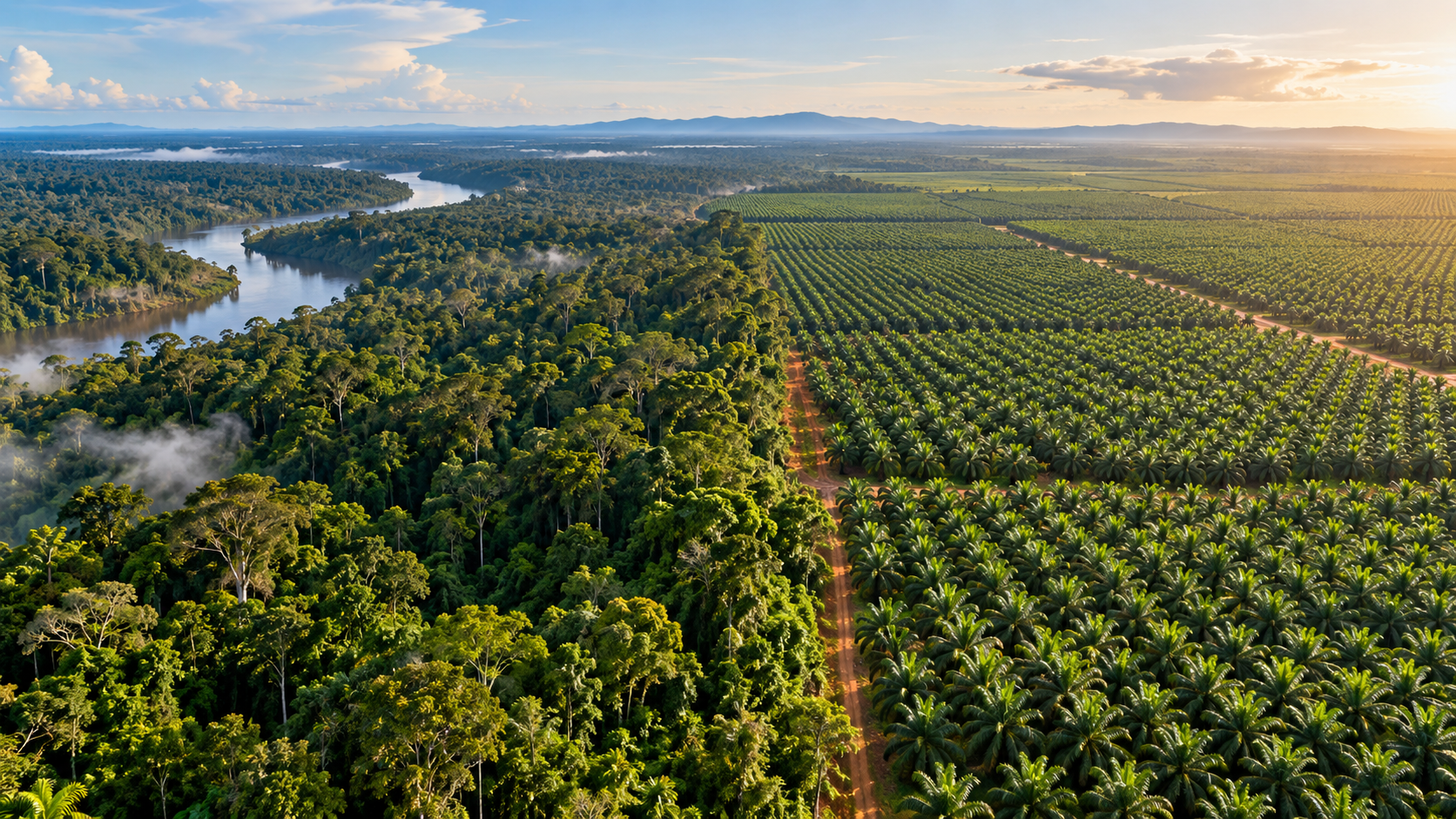
The expansion of the palm oil industry is creating new opportunities for palm kernel shell in Latin America, as countries such as Colombia, Brazil and others strengthen their position in the global palm sector.
For many years, the international palm oil industry has been dominated by Southeast Asia, particularly Indonesia and Malaysia. The same concentration has also shaped the global supply of palm kernel shell, a biomass fuel generated as a by-product of palm oil production.
However, Latin America is becoming increasingly important in the global palm industry.
According to USDA data for the 2025/26 marketing year, Colombia is expected to produce approximately 2.0 million metric tons of palm oil, while Guatemala is estimated at 995,000 MT, Brazil at 660,000 MT and Ecuador at 640,000 MT. Colombia is now one of the world’s leading palm oil producers and the largest producer in the Americas. FAS USDA
Palm Kernel Shell in Latin America: Colombia’s Growing Palm Oil Industry
Colombia provides one of the clearest examples of the region’s growing palm industry.
Fedepalma reported that Colombian palm oil production reached a record 1.93 million metric tons in 2025, an increase of 12% compared with 2024. Palm oil exports also increased substantially, with crude palm oil export sales rising from 382,000 MT in 2024 to 583,000 MT in 2025. Fedepalma
The growth continued into 2026. During the first seven months of the year, Colombia produced approximately 1.24 million MT, 3.1% higher than during the same period in 2025. Fedepalma
The country’s palm industry is also geographically broad. Fedepalma reports approximately 641,000 hectares of planted oil palm across 172 municipalities in 21 departments, demonstrating the scale of the industry’s established supply base. Fedepalma
This expanding production base is particularly relevant to the biomass industry because palm oil processing generates several biomass by-products, including palm kernel shell (PKS), mesocarp fiber and empty fruit bunches.
Brazil and the Amazon Region
Brazil represents another potentially important development.
Recent land-use data from Brazil’s National Institute for Space Research (INPE) and Embrapa show that perennial crops — including oil palm, cacao, citrus and coffee — expanded in previously deforested areas of the Amazon biome from 3,903 km² in 2022 to 4,824 km² in 2024, an increase of 23.6%. Serviços e Informações do Brasil
Oil palm development in the Amazon region, however, must be viewed together with environmental protection.
Research on Brazilian oil palm development has examined the possibility of expanding production on previously degraded land rather than primary forest. This approach is important because future palm industry growth will increasingly depend not only on production economics but also on traceability, land-use practices and sustainability requirements. CIFOR-ICRAF
Environmental concerns are also evident elsewhere in the region. Peru introduced a policy framework for sustainable oil palm development for 2025–2034, while environmental groups have raised concerns about how future agricultural expansion could affect Amazon forests. Peru currently has around 95,000 hectares under oil palm cultivation according to government figures cited in reporting on the policy. Conservation news
For international biomass buyers, this means that supply growth and sustainability verification will need to develop together.
What Does This Mean for Palm Kernel Shell?
Palm kernel shell is produced during palm oil milling and kernel processing. Therefore, a larger and more developed palm processing industry can potentially create a larger recoverable biomass resource.
But palm oil production alone does not automatically mean exportable PKS supply.
For PKS to become a practical international biomass fuel, several additional conditions must be considered:
- consistent PKS volume and quality;
- collection and stockpile capability;
- moisture and contamination control;
- distance between palm oil mills, stockpiles and loading ports;
- port and vessel-loading infrastructure;
- traceability and sustainability documentation; and
- commercially competitive ocean freight.
These factors will determine whether Latin American PKS can develop from a local palm-processing by-product into a reliable international biomass supply source.
A Potential New Supply Region for Korea
Korea has traditionally sourced PKS and other biomass fuels primarily from established Asian supply regions.
As Latin America’s palm oil industry develops, however, countries such as Colombia, Brazil, Guatemala, Ecuador and Peru deserve increasing attention as potential future sources of palm biomass.
Geographical distance to Northeast Asia remains an important commercial challenge. Freight economics, shipment size and port infrastructure will therefore be critical when evaluating whether individual suppliers can compete with established Southeast Asian PKS supply chains.
Nevertheless, supply diversification can become increasingly important for Korean biomass buyers seeking broader sourcing options and greater supply resilience.
For PKS Korea, the key question is therefore not simply how much palm oil Latin America produces.
The more important question is:
Which producers can provide reliable, traceable and export-ready PKS for the Korean biomass market?
PKS Korea will continue monitoring the development of the palm oil and palm biomass industries across Latin America as part of its worldwide PKS supplier network development.